Client intelligence for MSPs: how to stop flying blind on your accounts
TL;DR
Most MSPs are managing in the dark. They know a client is unhappy when the cancellation notice arrives. They know an environment has a problem when the ticket comes in. They know a QBR is coming when it's 48 hours away and they still need to pull data from four systems.
Client intelligence is the fix - the systematic use of data from your PSA, RMM, identity systems, and ticket history to give you continuous visibility into every account. When it works, you're proactively surfacing problems before clients notice, walking into QBRs with actual insights instead of spreadsheets, and spotting churn risk while you still have time to act.
The challenge is that most of the tools that claim to do this require a lot of manual setup, and the data they surface still requires interpretation. The opportunity - and where MSPs are increasingly getting an edge - is in using AI-powered ticket resolution to generate that intelligence automatically, as a byproduct of actually doing the work.
Why most MSPs are still flying blind
Consider what you actually know about each of your clients at any given moment.
You know which tickets are open. You know your SLA compliance. You know how many endpoints you're managing. If you've got a good RMM, you know patch status and backup health.
What you probably don't know: which accounts are trending toward churn. Which clients are sitting on legacy infrastructure you've never been asked to upgrade. Whether the 47 password reset tickets you closed this quarter for Acme Corp are a sign of a deeper identity management problem, or just a high-turnover retail business. Which of your clients would jump at a managed security offering if you framed the conversation correctly.
That's the visibility gap. And it's not a tool problem - most MSPs have PSAs, RMMs, and documentation platforms. It's a data integration problem: the signals are there, scattered across half a dozen systems, but nobody's connecting them into a coherent picture of each account.
The MSPs who are pulling ahead are the ones who've figured out how to close that gap.
What client intelligence actually means
Client intelligence, at its core, is the operational practice of turning raw IT data into actionable insight about each client relationship. It's three things working together:
Visibility - knowing what's in every client's environment in real time. Not just the assets you've catalogued, but what's running, how it's performing, where it's drifting from policy, and what's changed since last week.
Pattern recognition - connecting the dots across individual tickets and alerts to surface systemic issues. If three clients are all having the same Microsoft 365 authentication problems this week, that's not three separate incidents - it's one problem worth a proactive fix and a heads-up call.
Strategic context - understanding each account's business situation well enough to have a real conversation. What's the client's risk tolerance? What's their budget cycle? Are they in a regulated industry that's about to face new compliance requirements? Client intelligence gives you the context to be a strategic advisor, not just the people they call when email goes down.
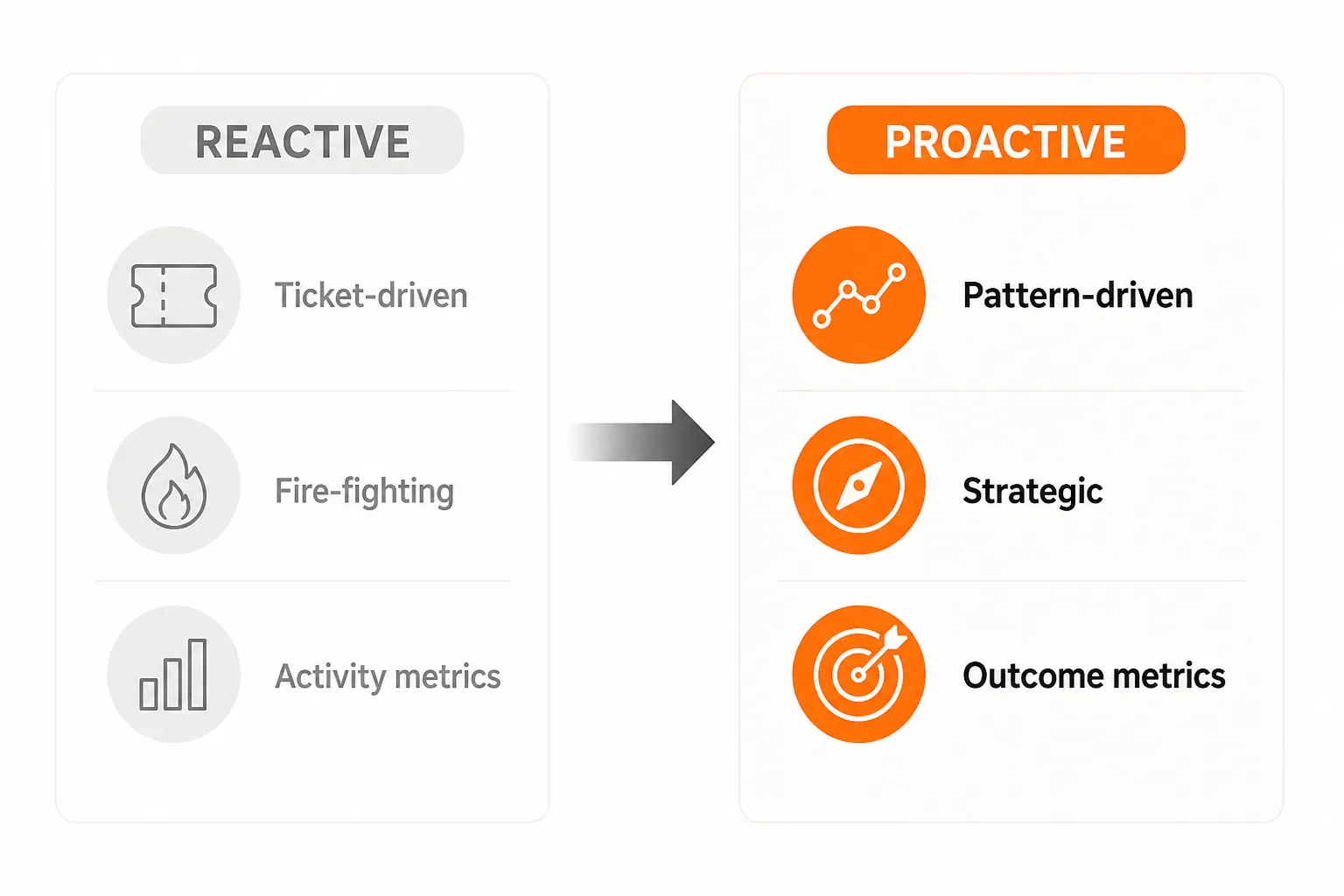
The shift this enables is real: from managing by exception (you find out about problems when they generate tickets) to managing by insight (you know about risks before they become problems). That's the difference between an MSP and what the industry is starting to call a Managed Intelligence Provider - a firm that's genuinely operating as a strategic partner rather than a reactive vendor.
The four problems client intelligence fixes
1. The QBR problem
Quarterly Business Reviews are the most powerful retention and expansion moment in the MSP relationship. They're also the most expensive to prepare for, and the most commonly squandered.
The typical QBR prep process: someone spends 4-8 hours pulling data from the PSA, formatting it in Excel, chasing down RMM reports, and building a slide deck - just to show the client a ticket count and SLA summary. The client sits across the table wondering why they're paying you this much money to report on problems you fixed, rather than telling them about problems you prevented.
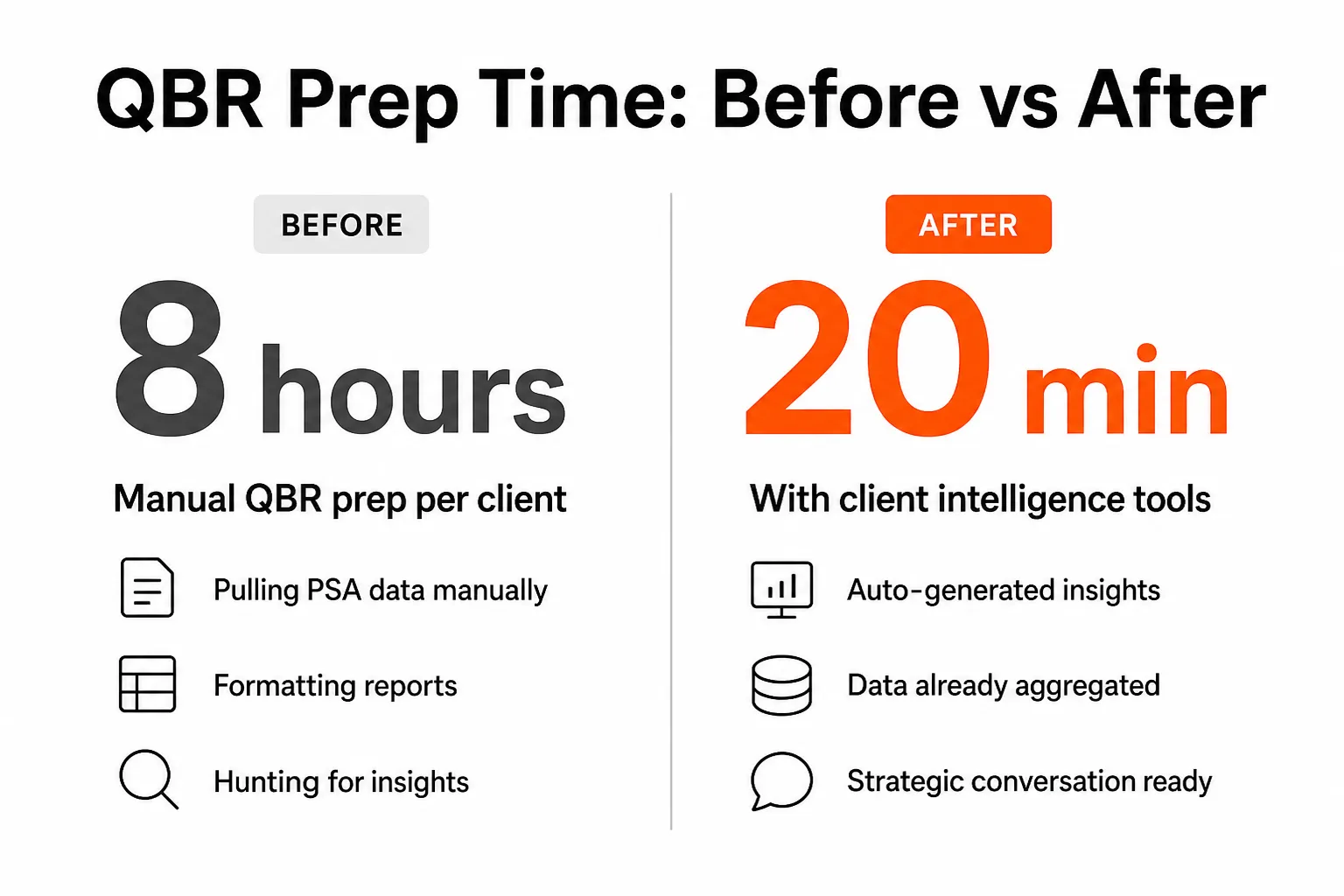
vCIOToolbox's Fusion 360 AI assistant is built specifically for this problem - it ingests PSA, RMM, and compliance data, surfaces strategic initiatives and risk areas, and generates QBR-ready documentation automatically, cutting prep time from hours to roughly 20 minutes per client. BrightGauge (part of ConnectWise) does the dashboard and reporting layer - if you're already in the ConnectWise ecosystem, it's the fastest way to get client-facing metrics that look like you actually know what's happening.
But the deeper issue isn't just prep time. It's that most QBRs are activity-based ("here's how many tickets we closed") rather than outcome-based ("here's how much downtime we prevented, here's what it would have cost you"). Client intelligence gives you the data to make that shift - and that's what moves clients from thinking of you as a cost center to thinking of you as a strategic investment.
2. The churn risk blindness problem
The most common way MSPs find out a client is unhappy: they get a cancellation notice.
By that point, there's usually been 3-6 months of warning signs that nobody caught. A decline in the client's responsiveness to recommendations. A string of escalations that never got permanently resolved. A QBR they missed without explanation. A shift in contact - suddenly you're talking to a new IT coordinator who seems skeptical of everything you're doing.
Client intelligence creates an early warning system for these signals. Thread builds this directly into its platform - its Client Intelligence feature analyzes service desk conversations for sentiment, surfaces recurring issues and emerging risks, and flags accounts where the relationship health is trending in the wrong direction.
The MSPs who are best at retention aren't the ones with the best SLA compliance. They're the ones who know which accounts are at risk before those accounts know they're considering leaving.
3. The missed upsell problem
How do you know which clients are ready for a managed security offering? Or a cloud migration? Or a disaster recovery upgrade?
If you're like most MSPs, the answer is: you don't, unless they ask. And clients rarely ask for things they don't know they need.
Client intelligence closes this gap. An asset inventory that tracks configuration against policy shows you the client running 15-year-old server hardware - not a ticket, just a risk sitting quietly in the environment. A compliance monitoring layer shows you the healthcare client who's three months from a HIPAA audit with gaps in their backup documentation. A service consumption analysis shows you the client who's paying for 50 M365 licenses but only using 38 - both a billing conversation and an opening for a security review.
Liongard does the asset discovery and configuration monitoring piece well - it continuously tracks what's in each environment, detects changes, and surfaces configuration drift. It's not a strategic advisory platform, but it's the foundation layer without which none of the strategic stuff is possible.
4. The data silo problem
The fundamental issue underlying all of this is that MSP data lives in too many places with too little connection between them.
Your PSA has ticket history. Your RMM has performance and patch data. Your identity platforms have access and authentication data. Your documentation system has asset inventories and runbooks. Your billing system has service consumption data.
None of these systems talk to each other automatically, which means the person who could theoretically connect all these signals - the account manager, the vCIO, the operations lead - has to do it manually. And because manual data aggregation is expensive and time-consuming, it usually doesn't happen until something goes wrong.
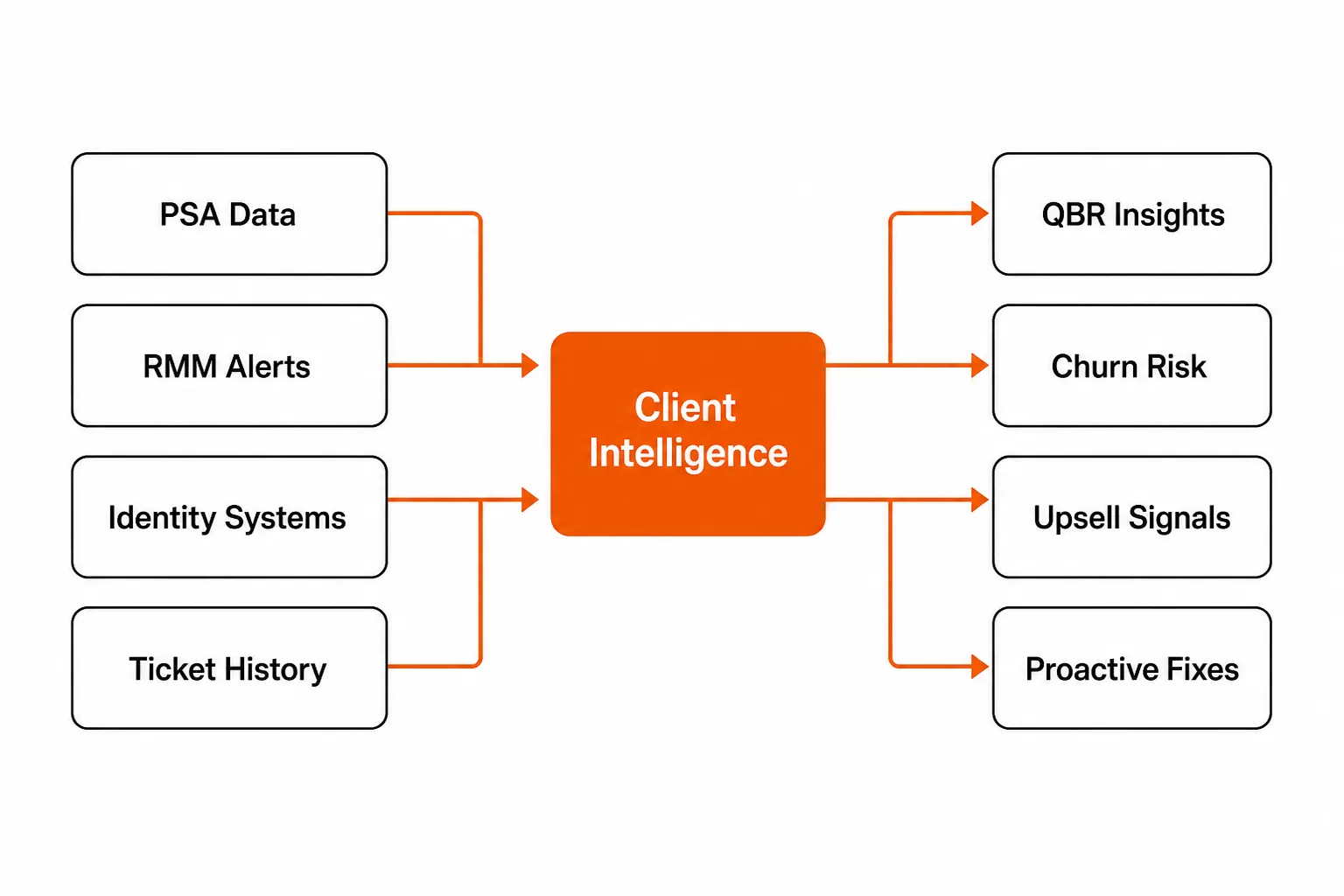
The emerging category of client intelligence platforms - Thread, vCIOToolbox, BrightGauge, Liongard - all tackle this from different angles. Thread focuses on the service desk conversation layer. vCIOToolbox focuses on the strategic advisory layer. BrightGauge focuses on the reporting and dashboard layer. Liongard focuses on the asset discovery and compliance layer.
Which one you need depends on where your biggest gap is.
The tools doing it in 2026
The client intelligence market has settled into a few distinct layers, each addressing a different part of the problem. Understanding what each one does - and what it doesn't do - is how you figure out where to start.
Asset visibility: Liongard
Liongard is positioning itself as the "System of Authority for Asset Intelligence." At its core, it's an automated asset discovery and compliance monitoring platform - it continuously catalogues what's running in each client environment, tracks configuration changes, and flags deviations from policy standards.
What it does well: the visibility foundation. If you don't know what's in an environment, you can't manage it, and you certainly can't sell a strategic conversation about it. Liongard solves that problem reliably. It runs automated discovery scans, maintains a history of changes (what changed, when, who made it), and integrates with major PSA and RMM platforms.
What it doesn't do: business insights. Liongard tells you what's there and whether it's compliant - it doesn't tell you what to do about it strategically or how to frame it in a client conversation. It's an input layer, not an output layer.
Pricing is per-node, which means costs scale with the size of environments you're managing - worth mapping out before committing.
Reporting and dashboards: BrightGauge
BrightGauge, now part of ConnectWise, is the workhorse of the MSP reporting space. It takes raw data from your PSA, RMM, and other tools and turns it into dashboards and client-facing reports - SLA performance, ticket trends, response time summaries, anything that needs to be visualized and presented to a client.
The practical value: you can build a QBR report template once and pull a fresh version for any client in minutes, rather than spending hours in Excel. BrightGauge connects to 40+ tools, which means if your stack is relatively conventional, you can have dashboards running pretty quickly.
The limitation: BrightGauge is a reporting layer, not an insights layer. It shows you what happened; it doesn't tell you what it means or what to do next. The interpretation is still on you, which means its value is proportional to the quality of questions you're asking.
If you're already in the ConnectWise ecosystem, BrightGauge is the obvious starting point. If you're not, it's worth evaluating alongside the other options.
Strategic advisory: vCIOToolbox
vCIOToolbox is the platform for MSPs that have moved beyond basic reporting and want to systematically run QBRs, manage compliance across clients, and track account health at scale.
Its Fusion 360 AI assistant is the feature that most directly addresses the QBR prep problem - it aggregates data from your PSA and RMM, surfaces strategic initiatives and risk areas, and generates the QBR agenda and supporting documentation automatically. The reported time savings are significant: from 6-8 hours of manual prep to roughly 20 minutes per client, which at any reasonable billing rate represents a substantial operational improvement.
vCIOToolbox also includes GRC (Governance, Risk, Compliance) capabilities through its Cybrance product, which is relevant for MSPs serving clients in regulated industries. The platform tracks compliance against frameworks like NIST, CMMC, and SOC 2, which turns compliance gaps into documented upsell opportunities.
The realistic consideration: vCIOToolbox is a complete platform, which means it has a learning curve and likely a higher price point than point solutions. It's the right tool for MSPs that have already solved the basics and are trying to systematize the strategic layer - not the right starting point if you're still building out your PSA discipline.
Service desk intelligence: Thread
Thread is doing something different from the other tools in this space. Rather than building a separate intelligence layer that sits on top of your existing tools, Thread integrates directly into the service desk workflow and generates client intelligence as a byproduct of doing the work.
Its Client Intelligence feature analyzes service conversations and tickets automatically, surfaces recurring issues and emerging risks, updates client-specific knowledge bases from every resolved ticket, and lets you query across your service data in natural language ("What's driving ticket volume for Acme Corp this quarter?"). The QBR preparation piece specifically gets real-time client health data, trend analysis, and sentiment tracking - all pulled from the actual service desk activity rather than manually aggregated.
The positioning that Thread has staked out - "transforming service desk activity into continuous, actionable intelligence" - is where the market is heading. The firms that understand this concept are winning the intelligence-led MSP category right now.
Where AI changes the math
The traditional client intelligence problem is a data problem: you have signals scattered across too many systems, and connecting them manually is too expensive to do consistently.
AI is changing this in two ways.
AI-powered reporting and synthesis - tools like vCIOToolbox's Fusion 360 use AI to aggregate, analyze, and summarize data that would otherwise require hours of manual work. This makes the strategic layer accessible to MSPs that don't have a dedicated vCIO on staff.
AI-powered ticket resolution as an intelligence source - this is the more interesting development. When an AI system is autonomously resolving tickets - actually doing the work of resetting passwords, unlocking accounts, handling onboarding - it generates a byproduct that's genuinely valuable: a precise record of what's happening across every client environment, at a granularity no human review process can match.
If an AI technician resolves 200 tickets a month for a single client, it knows: which users are getting locked out repeatedly and why, which systems are generating the most incidents, whether issues cluster around specific times or events, and which problems are getting resolved versus which ones keep recurring. That's client intelligence - not derived from a separate analytics layer, but generated automatically as a byproduct of doing the work.
Tyqra is designed for MSPs that want practical ticket automation without maintaining a separate workflow engineering team.
This is the emerging model: not just using AI to analyze your existing data, but using AI execution to generate better data in the first place.
How to think about building your client intelligence stack
You don't need to buy all of this at once. Client intelligence is a layered problem, and the right starting point depends on where your biggest gap is.
If you don't know what's in your clients' environments: Start with Liongard. Asset visibility is the foundation. You can't have a strategic conversation about an environment you can't inventory.
If you're spending too much time on QBR prep: BrightGauge is the fastest path to reducing that overhead if you're in the ConnectWise ecosystem. vCIOToolbox is the more comprehensive solution if you want to systematize the strategic advisory process.
If you're losing clients and not seeing it coming: Thread's Client Intelligence feature is built specifically for this problem. It's worth evaluating if account health visibility is your biggest gap.
If your biggest opportunity is proving ROI on the work you're already doing: The combination of an AI ticket resolution layer (which generates precise execution data) with a reporting or advisory layer on top is increasingly where the leading MSPs are going. The execution data gives you something concrete to report on; the advisory layer helps you translate it into client conversations.
The common thread across all of these is the shift from activity-based MSP operations to outcome-based ones. Clients don't actually care how many tickets you closed. They care whether their business ran well, whether problems got fixed before they became expensive, and whether you're the kind of partner who surfaces risks they didn't know they had.
Client intelligence is what makes that shift possible.
Try Tyqra
Tyqra is an AI technician purpose-built for MSPs - it connects to your entire stack (ConnectWise, Autotask, Halo PSA, Datto RMM, NinjaRMM, M365, Entra ID, Okta, JumpCloud, IT Glue, Hudu) and autonomously resolves L1 and L2 tickets the same week you deploy it.
Where Tyqra fits the client intelligence conversation: every ticket Tyqra resolves - every password reset, account unlock, onboarding, offboarding - generates a precise, documented record of what's happening across each client environment. At $3 per ticket outcome (no charge if Tyqra couldn't move the ticket), a typical MSP handling 200-400 automatable tickets a month recovers 50-100 hours of tech time and generates a detailed operational picture of every account in the process.
14-day free trial, no credit card required. Start here.
Frequently Asked Questions
What is client intelligence for MSPs?
Client intelligence is the systematic collection and analysis of data about each client's IT environment, service consumption, and business outcomes. It goes beyond ticket counts and SLA metrics to give MSPs strategic visibility - what's running in each environment, which accounts are at churn risk, where upsell opportunities exist, and how to walk into a QBR with data that proves value rather than just showing up.
What tools do MSPs use for client intelligence?
The main tools are: Liongard for asset discovery and compliance monitoring, BrightGauge (now part of ConnectWise) for PSA/RMM reporting and dashboards, vCIOToolbox for strategic QBR prep and account management, and Thread for turning service desk conversations into ongoing client intelligence. AI-powered ticket resolution tools like Tyqra also contribute directly - every resolved ticket surfaces patterns about recurring issues and systemic problems across client environments.
How does client intelligence help with QBR preparation?
Traditional QBR prep involves manually pulling data from your PSA, RMM, and other tools - a process that takes 4-8 hours per client and still leaves you without strategic context. Client intelligence platforms aggregate this data automatically, generate insights about recurring issues, trend lines, and risk signals, and can reduce QBR prep from hours to 20 minutes per client while actually improving the quality of the conversation.
How can MSPs detect client churn risk before it happens?
Client intelligence surfaces churn risk through patterns that don't generate tickets: configuration drift, underused services, declining engagement with recommendations, persistent recurring issues that never get permanently fixed, and misalignment between what the client is paying for and what they're actually using. Tools like Thread analyze service desk conversations for sentiment and recurring patterns. Tyqra surfaces systemic issues through its autonomous ticket resolution data - if the same 3 users at a client account are getting locked out every other week, that's a signal the environment has a problem worth flagging.
What's the difference between MSP and Managed Intelligence Provider (MIP)?
A Managed Intelligence Provider (MIP) goes beyond traditional MSP work - rather than reacting to tickets and measuring activity, an MIP uses data to proactively surface insights, prevent problems before they become tickets, and position itself as a strategic advisor. The MIP model is emerging as the competitive moat for MSPs facing commoditization pressure. It requires client intelligence capabilities to deliver: asset visibility, proactive detection, strategic reporting, and outcome-based measurement rather than just SLA compliance.