Tyqra vs MSPbots: which tool for which problem
TL;DR
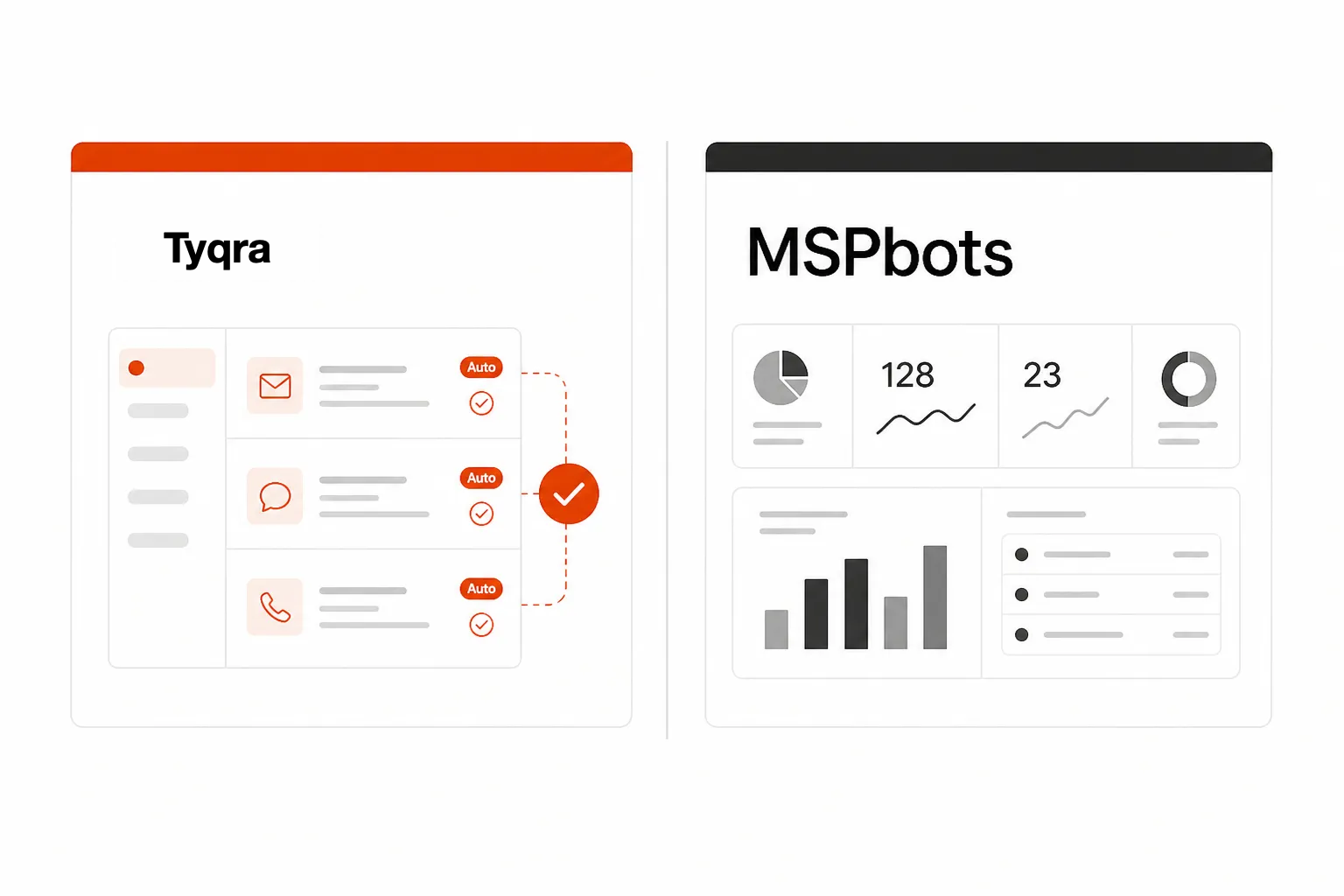
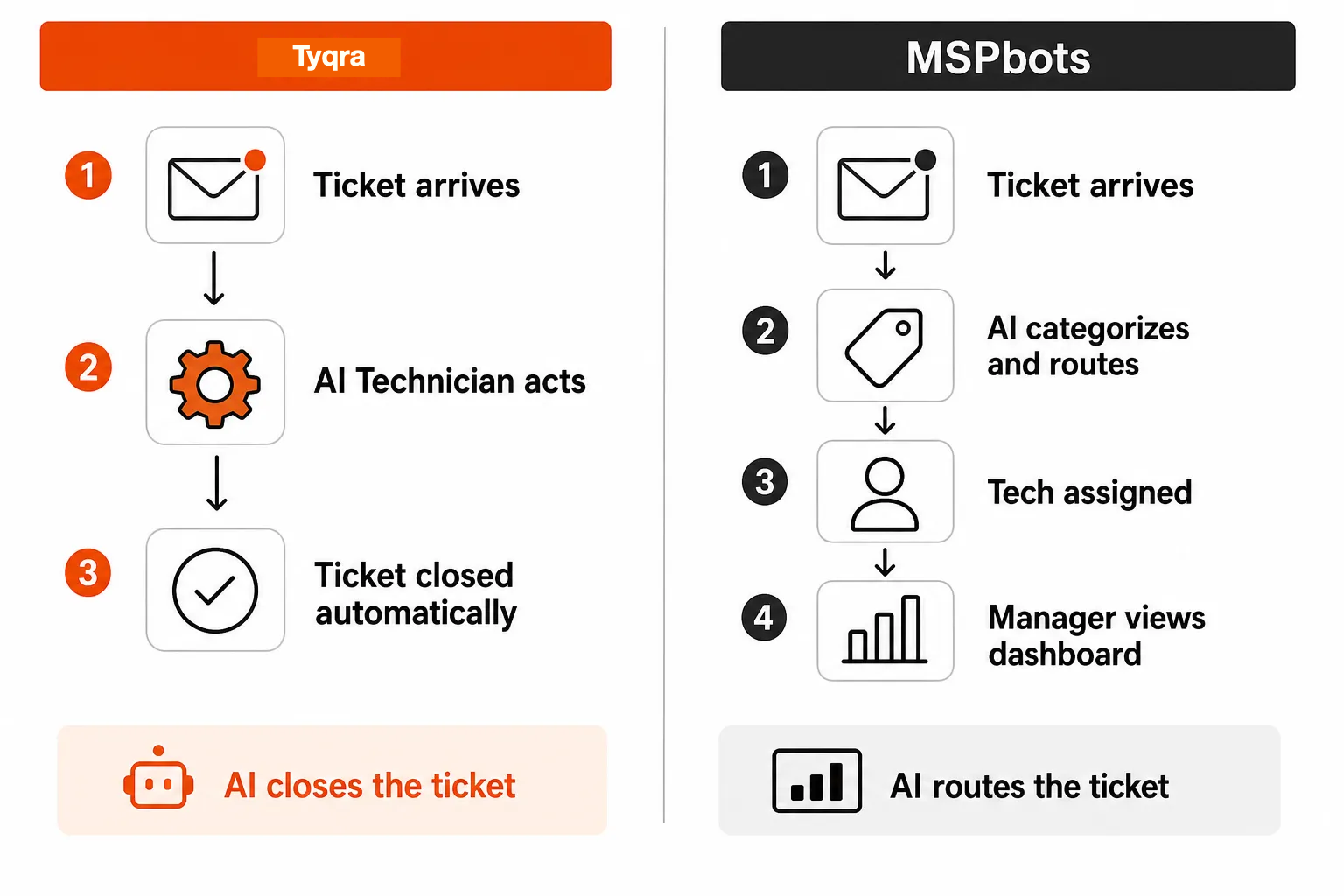
Tyqra and MSPbots are not competing for the same job. Tyqra is an AI technician that autonomously resolves L1/L2 tickets - it actually does the work (password resets, account unlocks, onboarding, offboarding) without a human touching the ticket. MSPbots is an operations platform that routes tickets to the right technician, tracks utilization, and gives managers business intelligence dashboards. One closes the ticket. The other decides who should.
If your pain is techs burning time on grunt work, Tyqra is what you're looking for. If your pain is no visibility into what's happening and tickets going to the wrong person, MSPbots is the tool. If you have both problems - and many MSPs do - they actually stack rather than compete.
The rest of this post covers what each tool does in plain terms, what you'll actually pay, and how to decide which problem you're solving.
Why "Tyqra vs MSPbots" is the wrong question
Most "vs" comparisons between MSP AI tools assume the tools are interchangeable. You're picking between two things that both claim to fix your ticket problem, and you want to know which one is better.
With Tyqra and MSPbots, that framing breaks down. They occupy different positions in the service delivery stack. MSPbots sits between the ticket landing and the tech - it classifies, routes, and provides context. Tyqra sits between the ticket and resolution - it executes autonomously, no tech required.
The honest version of this comparison is: which layer of your operation is actually broken?
If tickets are landing and not getting closed fast enough because L1s are eating senior tech time, that's an execution problem. If tickets are closing but routing is chaotic, utilization is invisible, and managers are flying blind, that's a visibility and routing problem. They're different diagnoses requiring different tools.
Both problems are real. Both tools are legitimate. The comparison only goes sideways when MSPs buy one expecting it to fix the other.
What Tyqra does
Tyqra launched as an AI technician - not a workflow builder, not a ticket summarizer, not a "suggested next action" engine. It connects to your full MSP stack and executes real work autonomously: password resets, account unlocks, mailbox permissions, group membership changes, onboarding flows, offboarding flows.
Tyqra is designed for MSPs that want practical ticket automation without maintaining a separate workflow engineering team.
The integration stack
Tyqra connects directly to the tools that hold the keys to execution:
- PSA: ConnectWise, Autotask, Halo PSA, SuperOps
- RMM: Datto RMM, NinjaRMM
- Identity: Microsoft Entra ID, Okta, JumpCloud, Google Workspace
- M365: Full Microsoft 365 integration for mailbox and license management
- Documentation: IT Glue, Hudu
- Project management: Atlassian
The identity integrations are what make autonomous execution possible. Tyqra can actually reset a password in Entra ID, not just flag the ticket for a human to do it. That distinction is the whole product.
Tyqra also handles voice - inbound L1 calls that get answered, diagnosed, and resolved without transferring to a human tech.
Pricing: $3 per ticket outcome
Tyqra's pricing is unusually clean for the space:
| Metric | Price |
|---|---|
| Per ticket outcome | $3 |
| Monthly minimum | $150 |
| Platform fee | $0 |
| Per-seat / per-tech licensing | $0 |
| Trial | 14 days, no credit card |
You pay when Tyqra does the work: it made a real change in one of your systems (reset the password, unlocked the account, created the mailbox) or ran one of your workflows start to finish. That's one $3 charge per ticket no matter how much work it took, and tickets Tyqra couldn't move are free. There's no per-action charge, no per-user seat, and no setup fee. If Tyqra resolves 500 tickets in a month, you pay $1,500. Under 50 outcomes, you pay the $150 minimum.
Spend controls (monthly cap, soft alerts at 50/75/90%) are built in.
What Tyqra doesn't do
Tyqra doesn't give you dashboards, utilization tracking, or business intelligence. It doesn't route tickets to human techs or manage dispatcher workflows. It doesn't have multi-client reporting or SLA health monitoring. If those are your needs, Tyqra isn't the answer - and to their credit, they don't pretend otherwise.
What MSPbots does
MSPbots is a different product category: it's an all-in-one MSP operations platform combining business intelligence dashboards, AI-powered ticket routing, and automation bots. It's been around longer than Tyqra and has 1,100+ MSP partners deployed - that's meaningful in a market where "early access customers" is still a common data point.
The feature set: BI, routing, and bots
MSPbots covers three distinct areas:
Business intelligence. Real-time dashboards pulling from 80+ integrated data sources, with 5,000+ pre-built templates. SLA health, technician utilization, profitability by client, stale ticket alerts, multi-client reporting with white-label branding. The BI layer is where MSPbots has the deepest history and the most user love.
AI Ticket Triage and Next Ticket. AI Ticket Triage categorizes and routes tickets within 30 seconds, claiming 90% accuracy from day one with improvement over time from feedback. The complementary Next Ticket feature assigns tickets to the right tech based on skill, SLA priority, and availability - removing the dispatcher bottleneck. One user on Tooliverse noted: "Midday open tickets went from 36 to 80 because we are actually processing them faster." That's routing doing its job.
Automation bots. No-code bots for Teams and Slack that handle attendance tracking, compliance reminders, and manager-like task accountability. Not ticket resolution - behavioral and operational automation for the team itself.
The 7.41/10 score on Tooliverse (from 155 verified reviews across G2, Capterra, Reddit, and Google) is real signal. A standout from a G2 reviewer: "The AI Sentiment Analysis caught a frustrated client before they even called us. That one save paid for the tool for the year." - Nate P., G2 via Tooliverse. Proactive intervention features like sentiment analysis are genuinely hard to find elsewhere in the MSP stack.
Pricing: $990/month flat
MSPbots' Professional Bundle is the most common entry point:
| Plan | Monthly | Annual |
|---|---|---|
| Professional Bundle (10 users) | $990/month | $900/month |
| Additional users (monthly) | +$99/user/month | +$90/user/month |
| Onboarding | Included | Included |
| Professional services included | 2 hours | 2 hours |
| Money-back guarantee | 120 days | 120 days |
For teams that want to build à la carte:
| Component | Price |
|---|---|
| Business Intelligence (PSA integration) | $179/month |
| BI (RMM or accounting integration) | $129/month |
| BI (other integrations) | $89/month |
| BI per admin user | $29/month |
| Bots | $45-50/user/month |
| Next Ticket | $45-50/user/month |
| Onboarding fee (per product, à la carte) | $299 |
The Professional Bundle is almost always the better deal at 10+ users given the math, but note that Bots requires purchasing Business Intelligence first. À la carte also comes with a slower support SLA (5-day vs 4-hour response).
What MSPbots doesn't do
MSPbots does not autonomously resolve tickets. It routes tickets to the right human tech - the human still does the work. It doesn't integrate with Entra ID or Okta for password resets. It doesn't handle offboarding flows or account provisioning. If a password reset ticket arrives, MSPbots will categorize it and send it to the right tech; Tyqra will reset the password. That's the core distinction.
Feature comparison
| Feature | Tyqra | MSPbots |
|---|---|---|
| Autonomous ticket resolution | Yes - closes tickets without human | No - routes to human tech |
| Password resets / account unlocks | Yes (via Entra ID, Okta, JumpCloud) | No |
| Onboarding / offboarding | Yes | No |
| AI ticket triage / categorization | Yes | Yes |
| Ticket routing to tech | No | Yes (Next Ticket) |
| Business intelligence dashboards | No | Yes (5,000+ templates) |
| Technician utilization tracking | No | Yes |
| SLA health monitoring | No | Yes |
| Client profitability reporting | No | Yes |
| Automation bots (Teams/Slack) | No | Yes |
| Voice (inbound call handling) | Yes | No |
| PSA integrations | ConnectWise, Autotask, Halo, SuperOps | ConnectWise, Autotask, Halo |
| Identity integrations | Entra ID, Okta, JumpCloud, Google | Not natively |
| Documentation integrations | IT Glue, Hudu | Limited |
| Deployment speed | Same week | Varies; setup complexity flagged in reviews |
| Pricing model | $3/ticket outcome, $150/month minimum | $990/month (flat) |
| Best fit | L1/L2 execution bandwidth problems | Routing + visibility problems |
Pricing in practice
The pricing models are structured so differently that a direct comparison requires some assumptions.
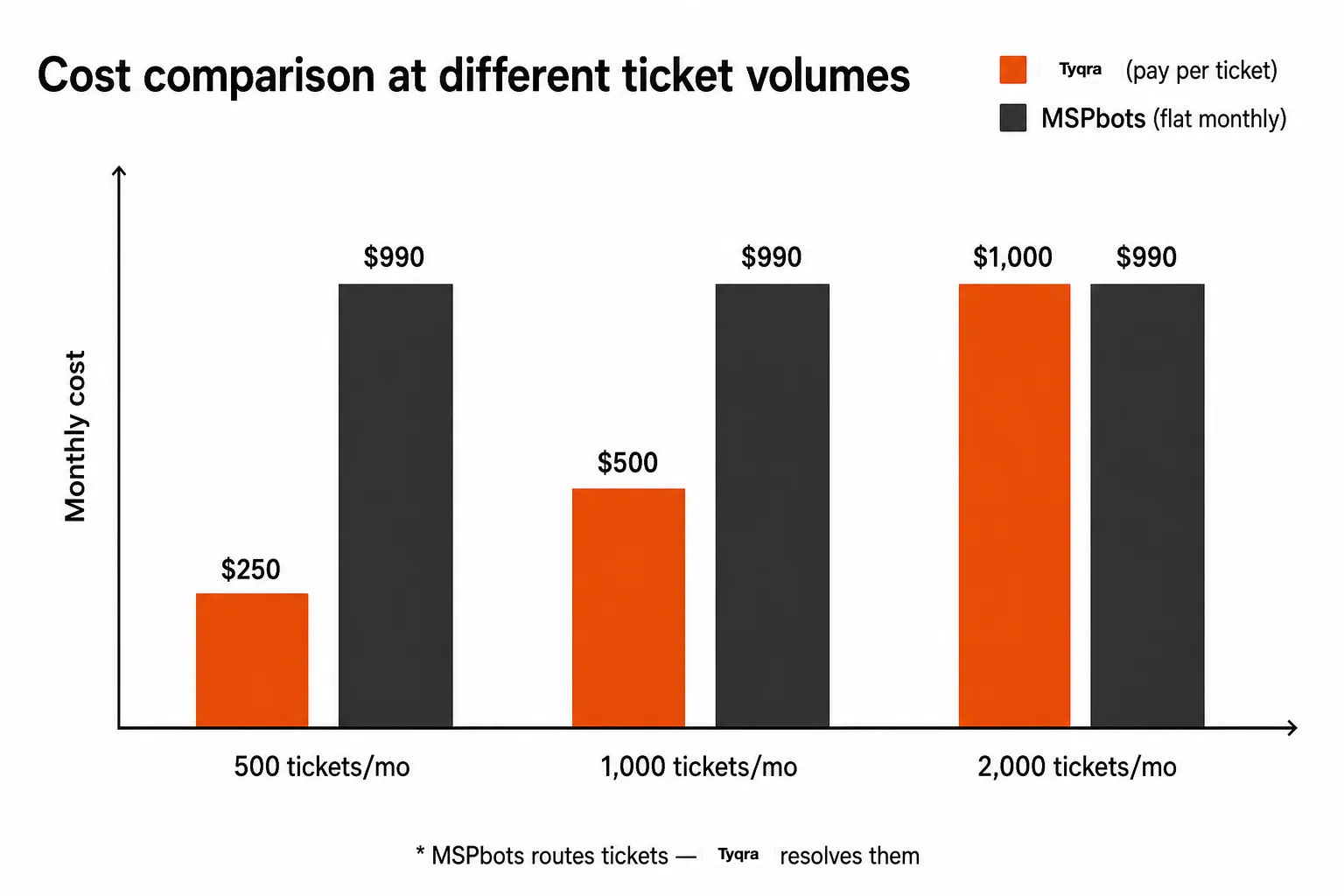
At 500 resolved tickets/month, Tyqra costs $1,500. At 1,000, $3,000. The crossover point against the MSPbots Professional Bundle rate of $990/month sits at about 330 resolved tickets a month.
But here's the honest version of that comparison: Tyqra is resolving those tickets (no tech required), while MSPbots is routing them to a human tech (who still has to do the work). They're not measuring the same output. Tyqra's effective value per dollar is the tech time it replaces, which at typical MSP billing rates of $100-150/hour is a completely different ROI equation than a routing tool.
Worked example, 10-tech MSP:
Assume 3,000 tickets/month total, 35% are L1s (password resets, account unlocks, basic access).
- L1 tickets: ~1,050/month
- At $3/outcome: ~$3,150/month from Tyqra
- Tech time saved (assuming 15 min each at $75 blended rate): ~$13,125/month in recovered capacity
- ROI multiple: roughly 4x
MSPbots at $990/month adds BI, routing, and utilization visibility to the 3,000 tickets. The ROI depends on how much dispatcher time and management overhead you're currently burning - 80% dispatcher time reduction is what MSPbots claims, and the Tooliverse reviews back that up for larger teams.
For small MSPs (under 10 techs), Tyqra's per-outcome model is typically the easier call. For larger MSPs already feeling the pain of invisible operations and routing chaos, MSPbots' fixed cost becomes easier to justify.
When Tyqra is the right call
You should look hard at Tyqra if:
- L1 tickets are consuming senior tech time. Password resets, account unlocks, permission changes - these are things a $25/hour tool should be handling, not a $90/hour engineer. If the gross margin impact of L1 work is visible in your P&L, Tyqra addresses the root cause rather than making it more efficient.
- You want to deploy fast and stop paying for setup. Same-week deployment with no implementation fees or training datasets puts Tyqra in a different category from tools that need months of configuration. The r/msp community has been clear that deployment speed matters - MSPs have been burned by tools that take quarters to get working.
- You have multiple identity platforms. If you're managing a client mix across Entra ID, Okta, JumpCloud, and Google Workspace, Tyqra's native integrations mean it can actually execute across all of them without separate scripting.
- Your pricing sensitivity is high. The floor is $150/month, so you can start small, measure actual resolution rates, and scale spending with volume. There's no $990 invoice before you've seen results, and tickets Tyqra can't move aren't billed at all.
When MSPbots is the right call
MSPbots makes sense when:
- You can't see what's happening in your operation. If managers are running on spreadsheets, ticket queue status is a mystery until someone shouts about it, and SLA breaches are discovered after the fact, the BI layer is what you need. 5,000+ pre-built dashboard templates covering utilization, profitability, and SLA health address that problem at scale.
- Ticket routing is chaotic. Cherry-picking tickets, dispatchers spending 2 hours a day on queue management, the wrong tech getting assigned the wrong problem - that's what Next Ticket is built to fix. If your dispatching function is the bottleneck, Tyqra won't help with that.
- You have 10+ technicians. The community consensus on MSPbots, per Tooliverse reviews, is that the tool pays off clearly at this scale. The fixed-cost model becomes more defensible when there are more users extracting value from the dashboards and routing automation.
- You want multi-client visibility and white-label reporting. If client QBRs are a meaningful part of your business and you're currently assembling those reports manually from PSA data, MSPbots' reporting layer is worth serious consideration.
One honest flag from community feedback: "We tried MSPBOTs and I found it pretty complicated personally and not easy to build dashboards in." Setup complexity is a real factor for smaller teams. The Professional Bundle includes onboarding and 2 hours of professional services, but custom dashboards beyond the templates require investment.
Can you use both?
Yes, and this is actually the more interesting question for growing MSPs.
Tyqra and MSPbots don't step on each other. Tyqra handles autonomous L1 execution - the tickets never get to a human. MSPbots handles routing, visibility, and operational intelligence for everything else. A mature MSP stack could look like: ticket arrives, Tyqra evaluates it, resolves L1s autonomously, routes L2/L3 to the queue, MSPbots assigns those to the right tech based on skill and availability, and managers have real-time visibility into all of it.
That's not a theoretical pairing - it's what happens when you address both problems separately with the right tool rather than hoping one platform does everything.
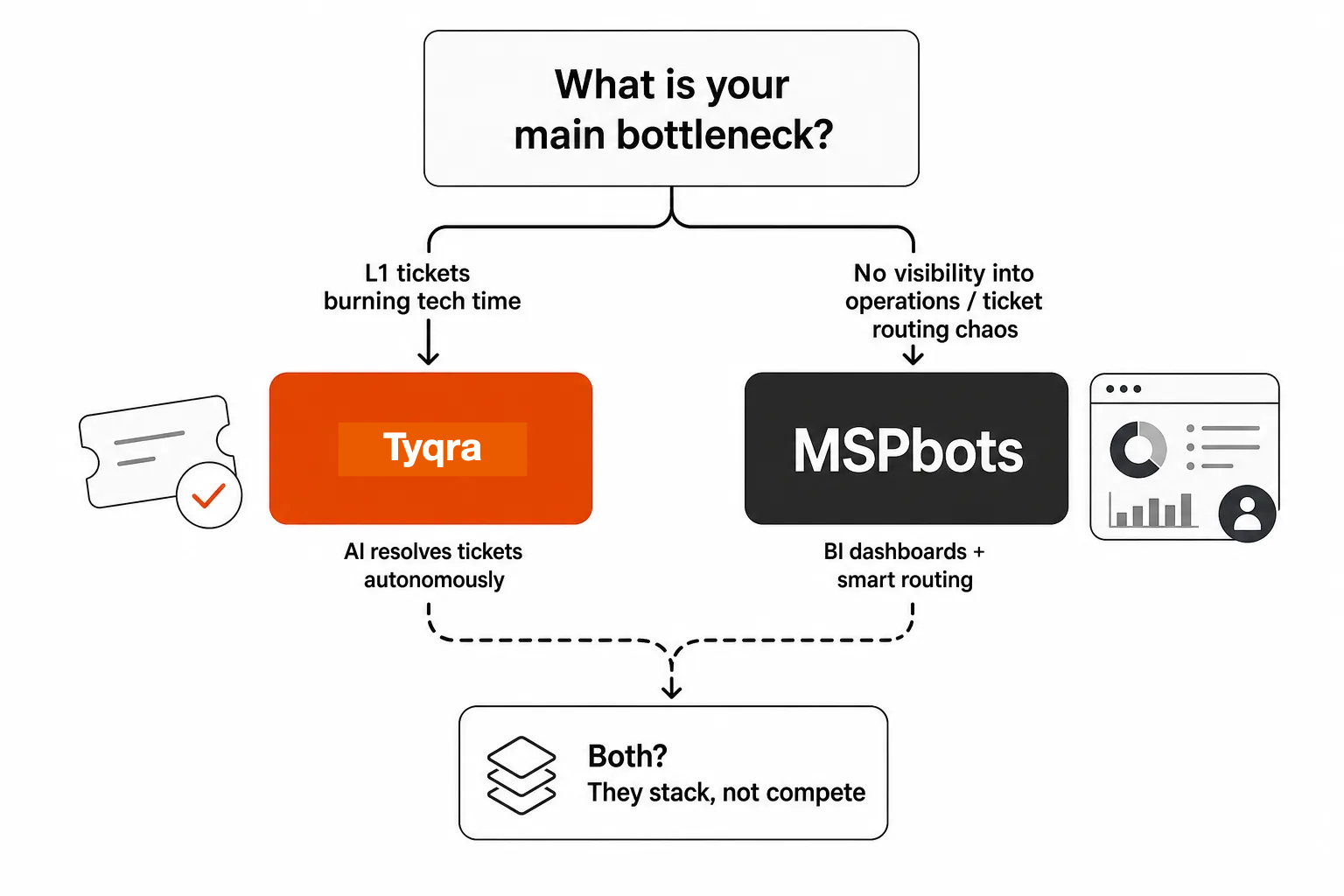
Budget-constrained? Pick the one that addresses your biggest current pain. Execution bandwidth problems (L1 tickets burning expensive tech time) → start with Tyqra. Routing and visibility problems (dispatch chaos, manager blindness) → start with MSPbots. Neither problem goes away on its own, so whichever you solve first, the other will still be waiting.
Verdict
Tyqra vs MSPbots is a false dichotomy - but if you have to choose one, diagnose before you buy.
If you've been watching password resets and account unlocks chew through senior tech hours and your only fix has been "hire another L1," Tyqra is built specifically for that problem. $3 per ticket outcome, same-week deployment, no admin overhead. The ROI case is straightforward: every L1 Tyqra handles is real money back in margin.
If you're managing 10+ techs and flying blind operationally - no real-time visibility into utilization, SLA health, or profitability - MSPbots is the more appropriate tool. The BI layer and routing automation it provides require real ticket volume and team size to justify the fixed cost, but for MSPs at that scale, it addresses problems Tyqra won't touch.
Most MSPs who look at this comparison eventually realize they have both problems. The good news is that these tools genuinely complement each other rather than overlap. For a condensed feature-by-feature table, see the MSPbots alternative page.
Try Tyqra
If the L1 execution problem resonates - tickets eating tech time, same tasks repeating every week, time-to-resolution dragged down by things a machine should handle - Tyqra is worth the 14-day trial. No credit card required, and it deploys in the same week rather than requiring a months-long implementation.
The differentiator, per the MSP community and Tyqra's own positioning, is real execution: Tyqra actually closes the ticket rather than suggesting what to do next. For an MSP audience that's been burned by tools that overpromise on that point, that distinction is worth testing firsthand.
Frequently Asked Questions
What is the main difference between Tyqra and MSPbots?
Tyqra is an AI technician that autonomously resolves L1/L2 tickets - it actually resets passwords, unlocks accounts, and handles onboarding without a human tech. MSPbots is an operations platform that routes tickets to the right technician and gives managers real-time business intelligence dashboards. Tyqra closes the ticket; MSPbots decides who should close it.
How much does Tyqra cost compared to MSPbots?
Tyqra charges $3 per ticket outcome with a $150/month minimum - if Tyqra resolves 500 tickets a month, you pay $1,500. MSPbots charges $990/month for up to 10 users (or $900/month on an annual plan). For lower ticket volumes, Tyqra is significantly cheaper; for very high volumes with a large team, MSPbots' flat rate can work out better - though the two tools do fundamentally different things, so cost-per-ticket comparisons aren't perfectly apples to apples.
Can Tyqra and MSPbots work together?
Yes - and for many MSPs, pairing them makes sense. Tyqra handles autonomous ticket resolution (the L1s), while MSPbots routes remaining tickets to the right human tech and gives managers visibility into the whole operation. They don't overlap: Tyqra is the execution layer, MSPbots is the routing and visibility layer.
How fast can I get started with Tyqra vs MSPbots?
Tyqra is built for same-week deployment - no 6-month implementation, no training dataset required, no dedicated admin overhead. MSPbots includes onboarding services in their Professional Bundle but community feedback consistently flags setup complexity as a real hurdle, particularly for teams without dedicated IT resources. Smaller MSPs should factor in configuration time when evaluating MSPbots.
Which is better for a small MSP - Tyqra or MSPbots?
For smaller MSPs (under 10 techs), Tyqra typically makes more sense. Its per-outcome model means you only pay for what gets resolved, the setup is faster, and the ROI is easy to quantify - every password reset Tyqra handles is tech time you didn't burn. MSPbots at $990/month is a meaningful fixed cost, and the community consensus is that it pays off best at 10+ technicians and higher ticket volumes where the routing and BI features have more data to work with.